Everything Worth Knowing About the Mercedes-Benz eSprinter
Jun 25, 2024
Everything Worth Knowing About the Mercedes-Benz eSprinter
The Mercedes-Benz eSprinter arrived in the US for the 2024 model year, and it's the first fully electric Sprinter available to American buyers. If you run fleets, do last-mile delivery, or you're just curious whether an electric van can actually do what a diesel Sprinter does, here's what you need to know.
What's different about it
Mechanically, the eSprinter shares the chassis philosophy of the rest of the Sprinter line but swaps the entire powertrain. Everything electrical sits up front. The battery packs live low in the underbody — good for center of gravity, good for cargo clearance. The motor drives the rear axle.
Powertrain
The motor is a permanent magnet synchronous design, weighs about 286 lbs, and is offered in 100 kW or 150 kW peak output. Torque tops out at 295 lb-ft. In practice: it moves a loaded van off the line much quicker than a diesel.
Battery and range
The flagship configuration pairs the 170" wheelbase high-roof cargo van with a 113 kWh battery — the largest they offer. It's a lithium/iron phosphate pack (no cobalt, no nickel), which trades a small amount of energy density for significantly longer cycle life and better thermal stability — a reasonable trade for a work van that'll see daily charging.
Rated range is up to 273 miles WLTP, up to 329 miles in city-cycle driving. Real-world, with load and climate control running, expect somewhere south of those numbers — the usual EV disclaimer.
Cargo and payload
- 488 cubic feet of cargo volume
- 9,370 lb GVWR
- 2,624 lb payload
- 11,023 lb GCWR for combined loads
eXpertUpfitter options let you spec the back for whatever the business requires — cargo management, mobile workshop, shuttle, etc.
Driver tech
Standard driver-assist on the eSprinter includes Active Brake Assist, Blind Spot Assist, and ATTENTION ASSIST. Optional extras worth noting:
- Digital rearview mirror with a high-dynamic-range camera. Actually useful in a windowless cargo van.
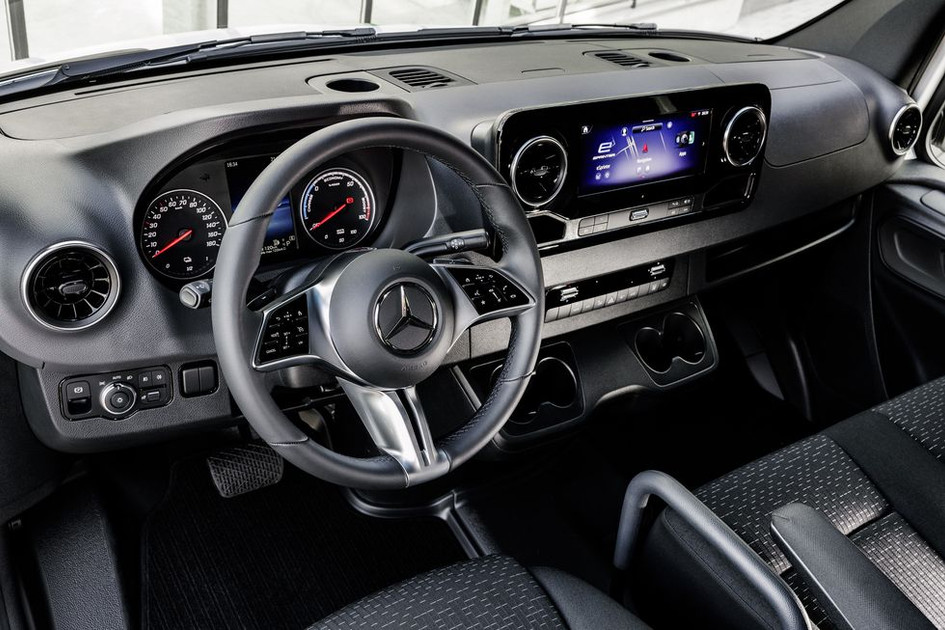
- MBUX — the touchscreen infotainment from the passenger-car side, now in the commercial line. "Hey Mercedes" voice assistant, customizable UI, the usual.
- Touch-sensitive steering wheel controls for audio and dash.
Efficiency features
Three drive modes (Comfort, Economic, Maximum Range) and five levels of regenerative braking controlled by the steering wheel paddles. "D Auto" handles regen dynamically. Mercedes me connect's "Navigation with Electric Intelligence" will route around charging stops based on current traffic and battery state.
Other standard equipment
- Active thermal management with a heat pump
- Keyless start
- All-season tires
- Front, side thorax-pelvis, and window airbags
- Eco-Assist
- Cruise control
- Hold function
- Trailer hitch prep wiring
- Load-adaptive ESP
Full spec sheet lives in the Mercedes-Benz eSprinter quick reference guide.
Charging
- AC (Level 2). Up to 9.6 kW. Full charge from a 240V/32A wallbox takes roughly 12.5 hours — fine for overnight depot charging.
- DC fast charging. Up to 115 kW. 10% to 80% in about 40 minutes on the 113 kWh pack.
- Mercedes me Charge. Aggregates access across ChargePoint, Electrify America, and EVgo — 85,000+ public charge points under one account, with remote session start and expense tracking from the app.
- Fleet depot solutions. Partnership with ChargePoint covers hardware, telematics, and fleet management software — including for mixed-brand fleets.
Service and warranty
Mercedes bundles scheduled maintenance for the first four years / 100,000 miles. The battery gets a certificate guaranteeing at least 70% of original capacity for eight years / 100,000 miles, with an optional extension to 185,000 miles / eight years.
EVs also have fewer moving parts than diesels — no timing chains, no turbos, no EGR systems to foul — so day-to-day maintenance is genuinely lower.
Pricing
At US launch, the eSprinter started at $71,866.12. Leasing is common for commercial vans — about 80% of Mercedes-Benz electric vans are leased globally. Launch lease terms on the 150 kW cargo configuration started at $998/mo for 36 months with $6,386 down.
For current MSRP, lease terms, and available configurations, check with your local MB Vans dealer — pricing and packages shift model year to model year.
Is it the right van for you?
For fleet operators running urban or regional routes with predictable daily mileage, the math is starting to work. The eSprinter's range covers most last-mile routes with margin, and depot charging means you're not paying diesel prices or dealing with EGR maintenance.
For vanlifers, the eSprinter is more complicated. The 273-mile highway range isn't great for remote travel, charging infrastructure thins out fast outside metros, and you can't easily add a big house battery system when the chassis battery already dominates the power architecture. The classic diesel Sprinter is still the better base for a serious full-time build.
If you're already in the Sprinter world, we carry upgrades and accessories for every Sprinter platform — electric included. Give us a call if you want to talk through what does or doesn't fit on the eSprinter chassis.
FAQs
Are there tax benefits with the eSprinter?
Commercial EV tax credits shift year to year at both the federal and state level. Depending on your business structure and where you operate, you may be eligible for federal commercial clean vehicle credits and state-level incentives — talk to your accountant before you rely on a specific number.
How many people does the eSprinter seat?
In standard cargo configuration, up to three including the driver. Passenger and shuttle configurations with more seats are available through upfitters.
Is the eSprinter an RV?
Not from the factory. It's a cargo van. Aftermarket camper conversions exist but are less common than diesel Sprinter conversions because of the range and charging-infrastructure limits.
How long does an eSprinter last?
Diesel Sprinters routinely hit 250,000–300,000 miles with basic maintenance. EVs have fewer moving parts and no combustion-related wear, so mechanical longevity is generally better — the bigger question is battery health. The warranty commits to 70% capacity at 8 years / 100,000 miles, and real-world LFP battery data suggests many will do significantly better than that.